
There was a point where I seriously weighed medication. I was dealing with impotence, and a prescription would have been the easy way out — my doctor could have written one on the spot. He didn’t. He asked a few honest questions instead, and gave me advice I didn’t want to hear: fix the source, not the symptom.
So I took a hard look at myself. Smoking, drinking, overeating, no training. My body wasn’t broken. It was neglected. The moment I quit the habits sabotaging my circulation and got serious about lifting again, things shifted on their own. No pills required. Just a body doing what it’s built to do.
That’s the lesson most men never hear: impotence isn’t bad luck. It’s a warning light. Your body telling you something needs maintenance.
The Mechanics Behind It
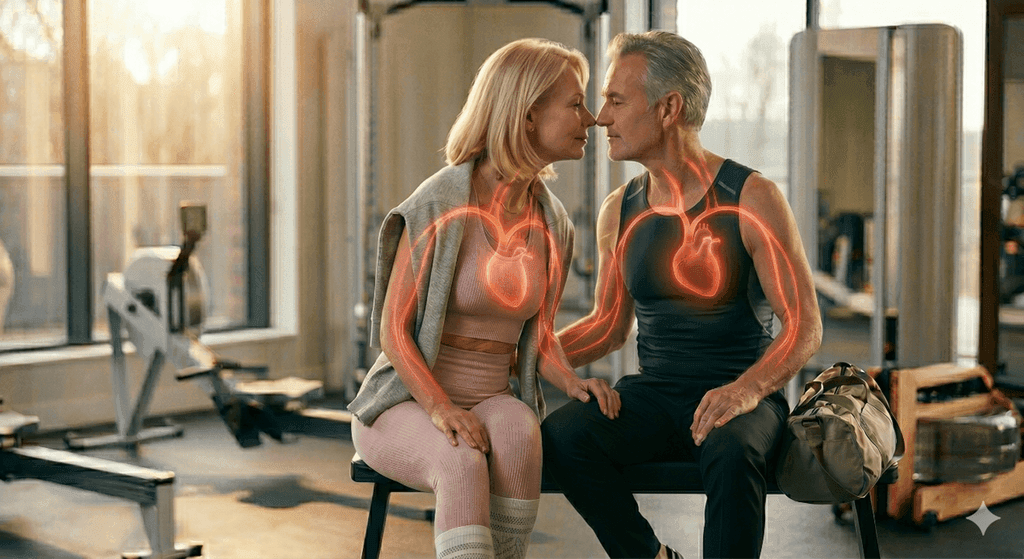
Arousal runs on blood flow. That’s not a figure of speech — it’s plumbing. Anything that strengthens your cardiovascular system is, in a very literal sense, training for your sex life too.
The research lines up with that. Resistance training triggers a surge in testosterone, the hormone behind sexual desire in every gender, not just men. People who train regularly show higher testosterone, stronger libido, and better sexual function than people who don’t — at the same age. Men between 40 and 75 who exercise consistently report significantly less erectile dysfunction than those who stay sedentary, mostly because exercise keeps blood moving everywhere it needs to go.
Three Levers, Not Thirty
Blood flow. Cardio builds pumping power. Strength training improves vascular integrity. Even a daily walk keeps circulation active. Smoking, heavy drinking, and sitting still all work against you here — no exceptions.
Hormonal balance. Testosterone, estrogen, growth hormone — none of it happens in a vacuum. Training stimulates production. Protein and healthy fats supply the raw material. Sleep is where your body actually uses it. Skip sleep, crash-diet, or stay chronically stressed, and you’re working against yourself.
Mental state. Stress kills libido about as fast as anything can. No training plan fixes a nervous system stuck in overdrive.
What Actually Changes After 50
For men, it’s usually a slow drop in testosterone and a slower response. For women, it’s the hormonal shift of menopause — falling estrogen, changes in sensitivity. Both are normal. Neither is fixed. What you do with your days decides how much of an impact they end up having.
More Isn’t the Answer
Overtraining backfires. Heavy volume without enough recovery raises cortisol and suppresses testosterone — the opposite of the goal. What worked for me, and what the research supports, doesn’t require anything exotic: strength training two to three times a week, one short high-intensity session, daily movement. Consistency did the work. Not intensity.
Your libido isn’t a separate system from the rest of your health. It’s one of the clearest signals you have for how your body is actually doing — I learned that the hard way. Energy, blood flow, hormones, stress: none of it is abstract wellness talk. It’s the actual biology of desire, and every part of it answers to how you train, eat, and sleep.
The Power of 50+ is built around exactly this — training, nutrition, sleep, stress, all of it working together. It’s the book I needed back then.
👉 thepowerof50.com